

Description
AQUALINK EDI SYSTEMS
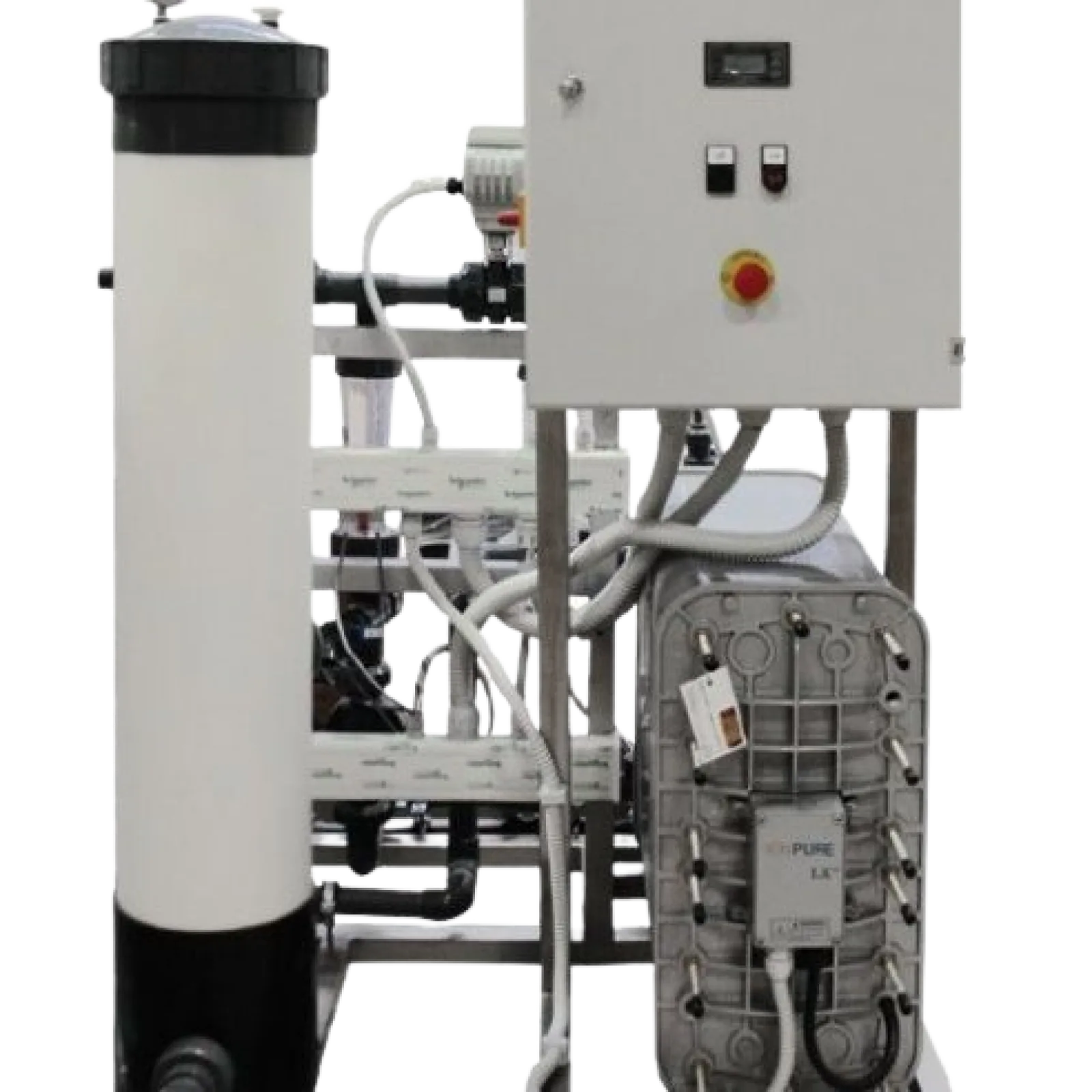
Standard CDI-Low systems are produced from 0.39 m3-hour capacity
up to 40.88 m3-hour capacity. It consists of single or up to 8 parallel
connected IONPURE CDI-LX modules. On its chassis, there are power supplies,
controllers, piping, sampling valves, chemical cleaning connections and
instrumentation that measures the flow and quality of water. If desired,
systems that can be sanitized with hot water (max 85 0C) can also be
manufactured. Standard CDI - High systems are produced between 22.7 m3-hour and
136.3 m3-hour capacity. It contains single and multiple Ionpure® VNX modules,
as well as power supplies, controllers, piping, sampling valves, chemical
cleaning connections and instrumentation measuring the flow and quality of
water on the chassis. Continuous electrodeionization is safe and reverse
osmosis is the only chemical-free way to upgrade product water to a higher
quality.
CDI - Low and High systems are systems that use a proprietary and
reliable process that produces continuous and high quality water with 18
megohm-cm product water quality without the need for deionization tanks or
regeneration chemicals.
ADVANTAGES OF THE EDI SYSTEM
EDI units are mechanically simpler than typical renewable ion
exchange systems.
EDI units can operate continuously 24/7 without the need to wait
for deionization regeneration.
In EDI systems, product water quality does not change over time,
whereas in renewable ion removal, product water quality decreases as the resin
begins to enter the saturation phase.
The most obvious benefit of EDI systems is the elimination of the
regeneration process and the avoidance of hazardous regeneration chemicals -
acids and caustics.
EDI systems do not have regeneration labor and chemical costs,
instead it consumes a small amount of electricity. Since the EDI concentrate
(or reject) stream contains only feedwater pollutants in 5 to 20 times higher
concentrations, it usually removes these pollutants without the need for
treatment, or is used in other processes.
By eliminating hazardous chemicals, workplace health and safety
can be increased. With increasing regulatory influences these days, workplaces,
storage, use, neutralization and removal of hazardous chemicals result in
additional costs such as documentation and surveillance to comply with
requirements set by law.
Since most of the impurities in the water are dissolved salts, the
deionization process usually produces water of high cleanliness close to pure
water, this process is fast and prevents the formation of sediment as a result
of precipitation.
